

Weeks after the widespread international internet restrictions, users are still waiting for a stable connection to return. What do the data reveal, and what lies behind this prolonged outage?
In recent weeks, the status of Iran’s international internet has become one of the most pressing concerns for users. Repeated promises to restore the internet to its state before January 8, 2026, have not materialized, leaving the public frustrated and uncertain. To better understand the situation, both technical data and official and unofficial narratives must be considered.
Iran’s Internet Through Global Data
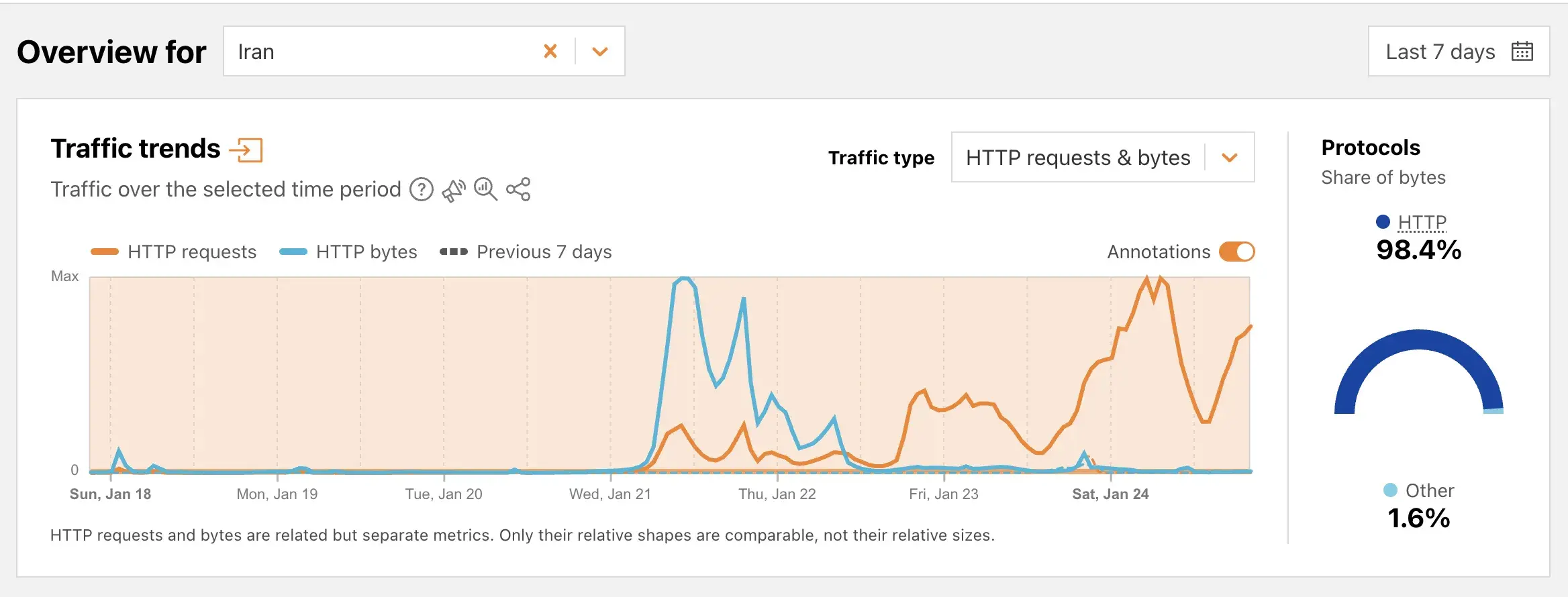
According to data released by Cloudflare Radar, after roughly two weeks of widespread blackout, signs of limited restoration appeared on Wednesday, January 21, and Thursday, January 22. This access was not widespread, reaching only about 24.6% of typical request levels at its peak.
Notably, during certain hours, bandwidth for a small group of users approached near-normal levels. However, the majority of users still lacked stable internet access, experiencing unequal connectivity.
Return of the Blackout and Drip-Feed Internet
This limited improvement did not last long. On Friday, internet conditions returned to blackout levels, with most users unable to send or receive data. Over Saturday and Sunday, while request levels fluctuated, bandwidth remained at its minimal state.
The result of this situation has been what many users call a “drip-feed internet”: technically operational, yet practically insufficient for everyday needs.
Why Is the International Internet Still Down?
This simple question has had no clear answer in recent days. Conflicting news, repeated “today and tomorrow” promises, and inconsistent communications have left users in a state of media confusion. One day, connections are expected on Tuesday, another on Thursday or Friday, and then on Saturday and Sunday—but each time, the result is only delay.
Hypothesis 1: Technical Issues
The first hypothesis points to technical problems. While the issue has been discussed at higher levels, its implementation has faced obstacles. Some experts believe the filtering infrastructure has been disrupted and restoring it requires complex adjustments and time.
The Role of Operators and Network Configurations
Some analysts also highlight differences in operators’ readiness. One provider may have adapted quickly to new changes, while another is still adjusting its protocols. This has resulted in unequal user experiences depending on the operator.
Hypothesis 2: Tiered Internet and Whitelists
Recently, discussions about a tiered internet have resurfaced. According to this view, delays in restoring international internet may be due to a new access structure. In this system, users’ access is defined by groups, and sites accessible to some may be blocked for others.
This kind of structure has been discussed previously and is now under renewed attention. It is closely related to concepts of internet filtering worldwide.
Hypothesis 3: Managing User Expectations
The third hypothesis takes a more skeptical approach. According to this view, neither technical issues nor tiered internet are the main factors; rather, the international internet is not intended to be fully restored in the short term. Repeated promises are primarily aimed at managing public sentiment and reducing pressure on authorities.
This hypothesis gained credibility when the Ministry of Communications stated that, contrary to some reports, no official order to restore the international internet had been issued, further increasing uncertainty.
Conclusion: Continuing Uncertainty
Overall, data and narratives show that Iran’s international internet remains shrouded in uncertainty. Users fluctuate between hope and disappointment, and there is no clear answer to when stable connectivity will return. Until transparent and accurate information is provided, this cycle of promises and waiting is likely to continue.
Frequently Asked Questions
Is the international internet completely cut off?
No, the internet is not entirely cut off, but access is limited, unstable, and has very low bandwidth for most users.
What is the main reason for the delay in restoring internet?
Various reasons have been suggested, from technical issues and network settings to the potential implementation of a new access structure. No definitive official answer has been provided yet.
What are your thoughts on this news? Share your opinion with us!
Last Updated on 26, January 2026 by admin | Published: 26, January 2026